
Computer vision for the prevention of ergonomic risks
Scenario
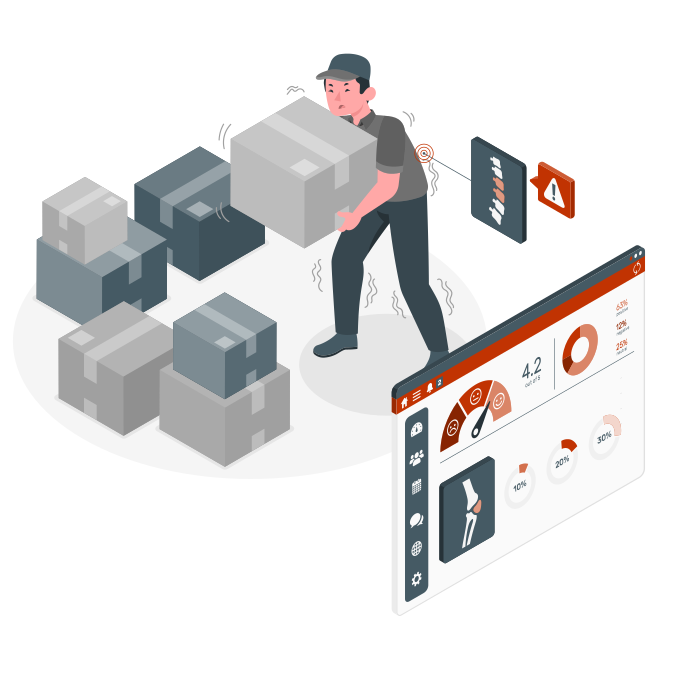
Occupational health and safety represent an absolute priority and a pillar of the social and economic responsibility of every company. Among the most widespread critical issues globally are Musculoskeletal Disorders (MSDs), which heavily impact workers' well-being and generate massive costs linked to absenteeism, decreased productivity, and insurance premiums. Traditionally, ergonomic risk assessment is performed through manual observations by specialists: a process that is often subjective, time-consuming, and limited to specific moments, unable to capture the true dynamism of daily activities.
In this context, INTEGRA (INtegrative AI Technologies for Ergonomic Guidance and Risk Assessment) was born, a project where the Deix team applied Mathematical Intelligence to transform ergonomic compliance from a static, bureaucratic obligation into a continuous, objective, and data-driven process.
The challenge
The project's complexity lay in the need to monitor ergonomics in real industrial environments without interfering with workers' operations and without using wearable sensors, which are often invasive or expensive. The main challenges addressed involved:
-
Single-camera analysis: Successfully and accurately calculating complex three-dimensional joint angles starting from the two-dimensional video stream of a standard fixed camera.
-
Simultaneous multi-person monitoring: Developing algorithms capable of tracking and evaluating multiple individuals concurrently within the same workspace, isolating relevant movements from background noise.
-
Overcoming the "Black-Box" approach: Avoiding the traditional AI approach that provides a result without explaining the reasoning behind it. For Health, Safety, and Environment (HSE) managers, it is essential to have scientifically transparent assessments based on recognized international standards.
-
Dynamic environments: Ensuring the accuracy of calculations even in the presence of lighting variations, shadows, or partial visual coverings (occlusions) typical of factory or warehouse settings.
The solution
Through a modular and proprietary approach, Deix developed an advanced Computer Vision and kinematic modeling pipeline. The solution goes beyond merely "observing", interpreting human movements by combining Deep Learning with body physics.
The three pillars of the INTEGRA solution are:
Intelligent 3D reconstruction: Starting from a standard 2D video, the system uses pose estimation algorithms to map the key points of the human skeleton, integrating them with depth estimation models and geometric algorithms to recreate posture in three-dimensional space.

Proactive prevention: By allowing the early identification of tasks with the greatest biomechanical overload, the tool provides HSE managers with the data needed to redesign workstations before injuries occur.

Physical constraints and "White-Box" approach: To eliminate AI errors, the model applies real physical and anatomical rules (kinematic constraints). If the algorithm detects an anatomically impossible movement, the system corrects it, ensuring explainable and repeatable assessments.
Results achieved
The project concluded with the successful validation of the algorithmic core in a laboratory environment, demonstrating the effectiveness of the approach on several fronts:
- 1
Continuous and objective assessment
The system eliminates human discretion, offering an objective and repeatable assessment of the risk associated with specific workstations or tasks.
- 2
Proactive prevention
By allowing the early identification of tasks with the greatest biomechanical overload, the tool provides HSE managers with the data needed to redesign workstations before injuries occur.
- 3
Modularity and "light" architecture
The software infrastructure was optimized to be scalable and ready to process large volumes of data without requiring expensive dedicated hardware.
Future developments
The models and pipeline developed within the INTEGRA project are part of the Varda-AI platform dedicated to worker monitoring and safety.
This methodology demonstrates how the union between artificial intelligence and mathematical rigor can automate health protection. It is a highly replicable solution across all sectors with intensive manual labor—such as manufacturing, logistics, packaging, or construction—where the protection of human capital is both an ethical duty and a strategic competitive advantage.