
Risk Scoring Models
Scenario

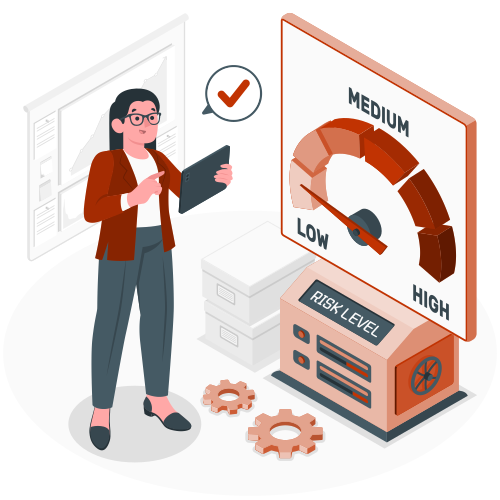
In today’s fast-changing markets, accurately assessing credit risk is essential for making informed financial decisions. Modefinance, a company specializing in risk analysis, already used several tools for this purpose but felt the need for a single system capable of providing a comprehensive and easily interpretable assessment of a company’s risk of default. To achieve this, they turned to Deix, which, thanks to its expertise in artificial intelligence and complex data analysis, proved to be the ideal partner.
The challenge
The main challenge was to create a tool capable of combining diverse and sometimes incomplete information into a single, easy-to-read, yet reliable indicator. This indicator needed to accurately estimate the likelihood that a company might encounter difficulties in the coming months by combining descriptive data with KPIs generated by existing statistical models. It was also essential that the results were understandable and transparent, allowing users to provide a clear and consistent justification for each assessment.
The solution
To meet Modefinance’s needs, Deix developed a custom software library, easily integrable into their existing systems. This library enables training and using a risk assessment model based on an advanced technology called the FT-Transformer. This type of neural network was originally designed to analyze complex data, such as text or time series, and here it has been adapted to work with the numerical and categorical data typical of companies.
The core of the solution is this model, which offers three key advantages:

Understanding complex data relationships
Thanks to a technique called self-attention, the model can detect even non-obvious connections between different pieces of information about a company, improving the accuracy of risk predictions.

Intelligent handling of missing data
Often, some information is not available. The FT-Transformer is designed to selectively ignore these gaps, preventing them from negatively affecting the results.
Transparency and explainability
In addition to providing a synthetic score, the library developed by Deix includes tools that help users understand why a particular company received a specific score, both at an overall level and in detail for each individual case.
Results achieved
The new model achieved excellent results: it was able to predict default risk with high accuracy, reaching a 90% (AUC) accuracy in identifying the most at-risk companies. This represents a significant improvement over previously used models.
Future developments
Transformers applied to corporate data are becoming increasingly powerful and flexible. Future developments will focus on models that are even lighter, faster to train, and capable of adapting in real time to new data.