
Satellite Data Fusion
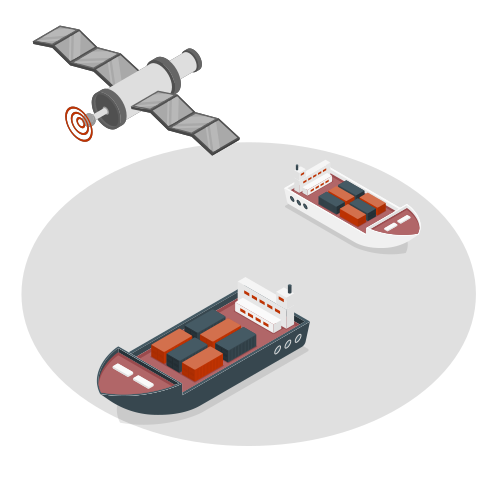
Scenario
In recent decades, the intensification of maritime activities has led to growing concerns regarding Maritime Surveillance (MS) and Maritime Situational Awareness (MSA). The ability to predict vessel trajectories is crucial for many critical applications such as search and rescue at sea, traffic management, route planning, and the allocation of satellite resources.
To identify and monitor maritime traffic, an automatic tracking system called AIS (Automatic Identification System) is used. However, the limitations of AIS represent a significant challenge, especially in cases of illicit activities or intentional manipulation of signals.
The fusion of data from satellite sensors offers a promising solution to overcome these limitations by improving monitoring capabilities across vast ocean areas.
The challenge
Monitoring based on AIS is often incomplete or unreliable, particularly in areas with poor coverage or when vessels intentionally manipulate signals to evade detection.
Furthermore, data from multiple satellite sensors (optical imagery, synthetic aperture radar - SAR, RF detections, and nighttime imagery) exhibit disparate characteristics in terms of temporal and spatial resolution, along with potential intrinsic errors or discrepancies.
The main challenge is to effectively integrate these heterogeneous data sources to detect and track vessels even in complex, high-traffic environments.
The solution
We developed an advanced algorithm based on optimization methods, capable of accurately associating AIS data with satellite detections from heterogeneous sensors. The algorithm has been engineered as an API, enabling the fusion of different data sources (AIS, SAR imagery, RF detections, nighttime lights, etc.).
The solution addresses temporal and spatial alignment issues through interpolation and projection techniques, as well as the use of kinematic and dimensional information to enhance accuracy in high-density traffic areas.
This multidimensional approach enables anomaly detection and successful vessel tracking, even in cases of incomplete or deliberately falsified signals.
Results achieved
The algorithm demonstrated over 95% accuracy in detection association, enabling accurate and reliable monitoring of maritime activities
The developed API provides a versatile tool for data fusion, making it applicable not only to the maritime domain but also to other sectors requiring multisource data integration.
Future developments
The techniques developed can be extended to various application areas such as land monitoring, environmental surveillance, emergency management, and security. The versatility of the API and algorithm allows for the integration of additional data sources, broadening its potential uses in different sectors and enhancing situational analysis capabilities.